Real Vs Faux Fur: Slavic Traditions and The Origin of The Fur Coat

Potentially one of the biggest debates in fashion and one of the most controversial pieces of clothing, the fur coat. If you eat meat and wear leather, your opinion that real fur is “cruel” is hypocritical.

The Origin of The Fur Coat
Fur coats date back centuries initially designed as a practical article of clothing for extreme climates. Created by prehistoric humans around 40,000 years ago, they were manufactured as a survival tool, a protection against arctic temperatures.
Prominent across Europe, North America, and Africa as a status symbol, animal hides symbolised social hierarchy and wisdom. While often worn by royalty as a sign of nobility, many other cultures wore fur for spiritual reasons.
Fur in Slavic Traditions
In slavic cultures, particularly Russian, real fur was both a status symbol and form of currency. During the Siberian Fur Trade, fur trade accounted for nearly 20% of Russia’s national treasury income. Up until 1739, the Russian national treasury accepted fox, beaver, sable, and other types of fur with some rulers using fur as a gift to foreign ambassadors and noble people.
Sable coats embroidered with gold or silver were famous amongst the Russian Tzars. With the vast majority of sables inhabiting Russia, particularly Siberia, foreigners' adoration for the extravagant fur coats, and the exclusivity of owning one themselves made them the ideal gift in relation to foreign affairs and friendship.
Traditional Russian fur coats were crafted from sable, fox, marten, mink, beaver, lynx, ermine, rabbit, and sheepskin. The expensive fur coats were made with sable, fox, marten, and ermine, while commoners primarily wore squirrel, lynx, or leopard.
During the soviet-era, through the 1950s and 60s, farmed fur such as mink and polar fox saw a rise in popularity, while wild caught sable remained the highest value fur.
The Introduction of Fur into Modern Day Fashion
Real fur coats were often passed down through generations, inherited from mothers and grandmothers. While real fur coats can last decades, services to repair and reline fur coats were wildly popular during the soviet-era, bringing old garments back to life.
During the 20th century, Europe's fascination with Russian culture — set in motion by Russian theatre and ballet — initiated Russian fashion appearances on the streets of Europe. The rise of Hollywood in the 1920s, also launched the popularisation of fur through western celebrities as a symbol of elegance.
While fur began to gain traction in western societies, the conversation of the ethics behind crafting real fur coats, fur farms, and hunting of innocent animals as a fashion statement grew.
Real Vs. Faux Fur
The debate continues today on whether faux fur is superior to real fur, environmentally.
6-11 snow leopard pelts are required to make a leopard fur coat.
8-18 lynx pelts are needed to manufacture a lynx fur coat.
10-40 fox pelts are required to craft a fox fur coat.
50-60 minx pelts are needed to make a minx fur coat.
60-80 sable pelts are required for the creation of a sable fur coat.
100-150 chinchilla pelts are required to create a chinchilla fur coat.
Real fur is high maintenance and needs to be stored in controlled climates to remain in a pristine condition.
Due to reasons of animal cruelty and environmental impacts, fur farming is prohibited in the UK, Austria, Croatia, Netherlands, Slovenia, Estonia, France, Italy, Belgium, Norway, and other regions.
I believe the continued production of fur coats is unnecessary and cruel; however my view does not lay with faux fur claiming the title of ‘better for the environment’.
Faux fur coats are made of plastic. They shed microfibers, and are non-biodegradable. Faux fur is also known to hold onto odors and stains which makes them more disposable. The environmental issues we are currently facing with fast fashion are driven by overconsumption and reliance on fossil fuel based fibres.
Fur is history, faux fur is landfill.
Rather than the current clothing cycle of buying, wearing, and then disposing of clothing, real fur coats are passed down through generations. Wearing high-quality second hand garments — such as real fur coats — reduces consumption and is arguably better for the environment. It is more sustainable to wear something already in existence than it is to buy something new.
While I, myself, own multiple faux fur coats — purchased prior to my investigation into faux vs real fur — moving forward my aim will be to solely purchase real VINTAGE fur coats.

How To Tell If Your Fur Coat Is Real
Unfortunately, the transparency of whether a coat is real or faux these days has become blurred with multiple markets in Australia being called out for marking real fur as faux.
So, how can you tell the difference between real and faux fur to make an informed decision on your purchase?
Faux fur is often lined by mesh or threaded fabric while real fur is still attached to the hide. While observing the fur it is important to inspect the tips. Real fur will come to a fine tip while faux fur has a more blunt end. Real fur also burns smelling like human hair, while faux fur has the smell of burning plastic as it is made from polyester or acrylic.
Should You Purchase Real or Faux Fur?
While we are all entitled to our own opinions, based on ethics, morals, and values, I believe that faux fur is just as bad, if not worse than the continued production of real fur coats.
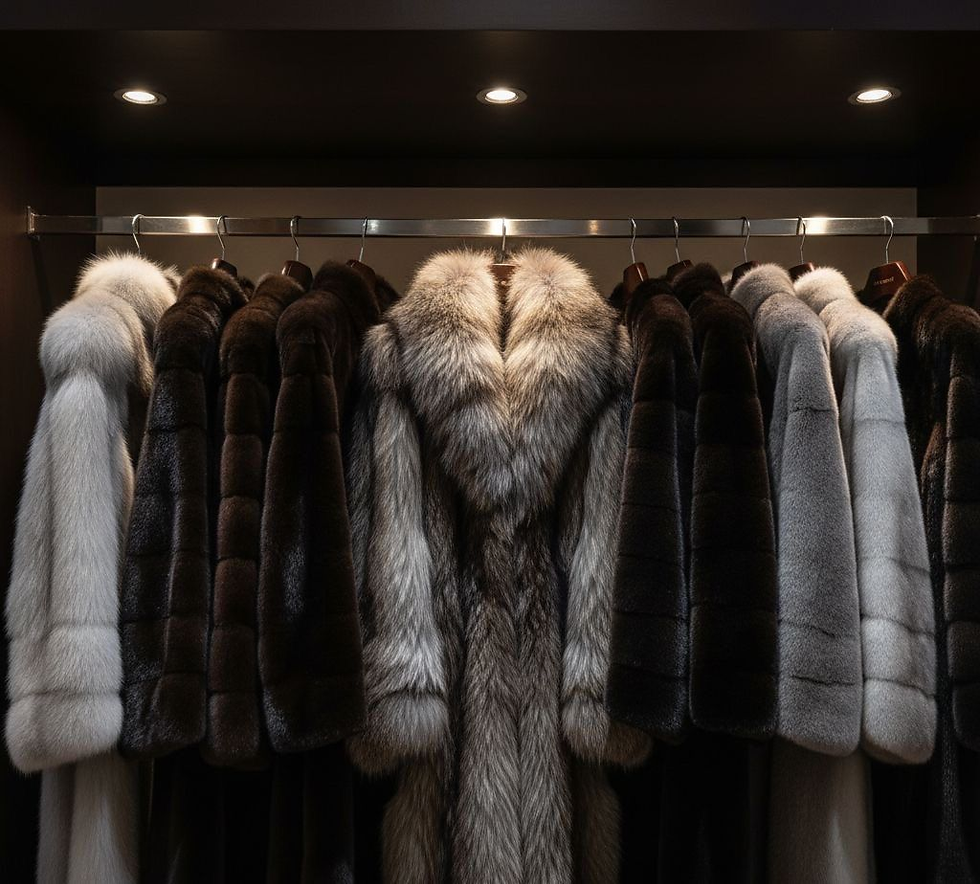
My advice to you, shop vintage, in person so you can feel the fur and be sure of what you are buying.
Love,
Innasya
References
The Fashiongton Post | Fur, Fishnets & Fake “Chanel”: USSR’s Closet Secrets https://fashiongtonpost.com/fur-fishnets-and-fake-chanel/#:~:text=The%20Allure%20of%20Fur%20in,for%20their%20quality%20and%20craftsmanship.
Fashion Network | Get the 'post-Soviet' look: how Russian street style went global https://ww.fashionnetwork.com/news/Get-the-post-soviet-look-how-russian-street-style-went-global,900654.html
PeTA Australia | How to Tell the Difference Between Faux and Real Fur https://www.peta.org.au/living/how-to-tell-the-difference-between-faux-and-real-fur/
The Guardian | How to tell if faux fur is actually real https://www.theguardian.com/lifeandstyle/shortcuts/2018/jan/24/how-to-tell-if-faux-fur-is-actually-real
Fur Traders | From Survival to Style: The Evolution of Leather and Fur in Fashion https://furtraders.com/blogs/blogs/from-survival-to-style-the-evolution-of-leather-and-fur-in-fashion
The Guardian | The vintage fur debate: does it honour an animal or normalise cruelty? https://www.theguardian.com/lifeandstyle/article/2024/aug/06/the-vintage-fur-debate-does-it-honour-an-animal-or-normalise-cruelty
Avanti | Furs in Russia https://www.avantifurs.com/fur-blog/furs-russia/


Comments